
Medically Reviewed by Dr. Alan McCaffrey on September 28, 2026

If you wake up feeling exhausted even after a full night in bed, the issue may not be how long you’re sleeping, but how well you’re breathing while you sleep. Dental sleep medicine offers a comfortable, non-invasive way to help you rest more deeply and wake up with more energy.
At Red Rock Dental, our team has spent over 20 years helping Las Vegas patients take a proactive approach to their health. Through our sleep apnea treatment, we provide custom oral appliance therapy designed to keep your airway open throughout the night, so you can finally wake up feeling like yourself again.
What Is Dental Sleep Medicine?
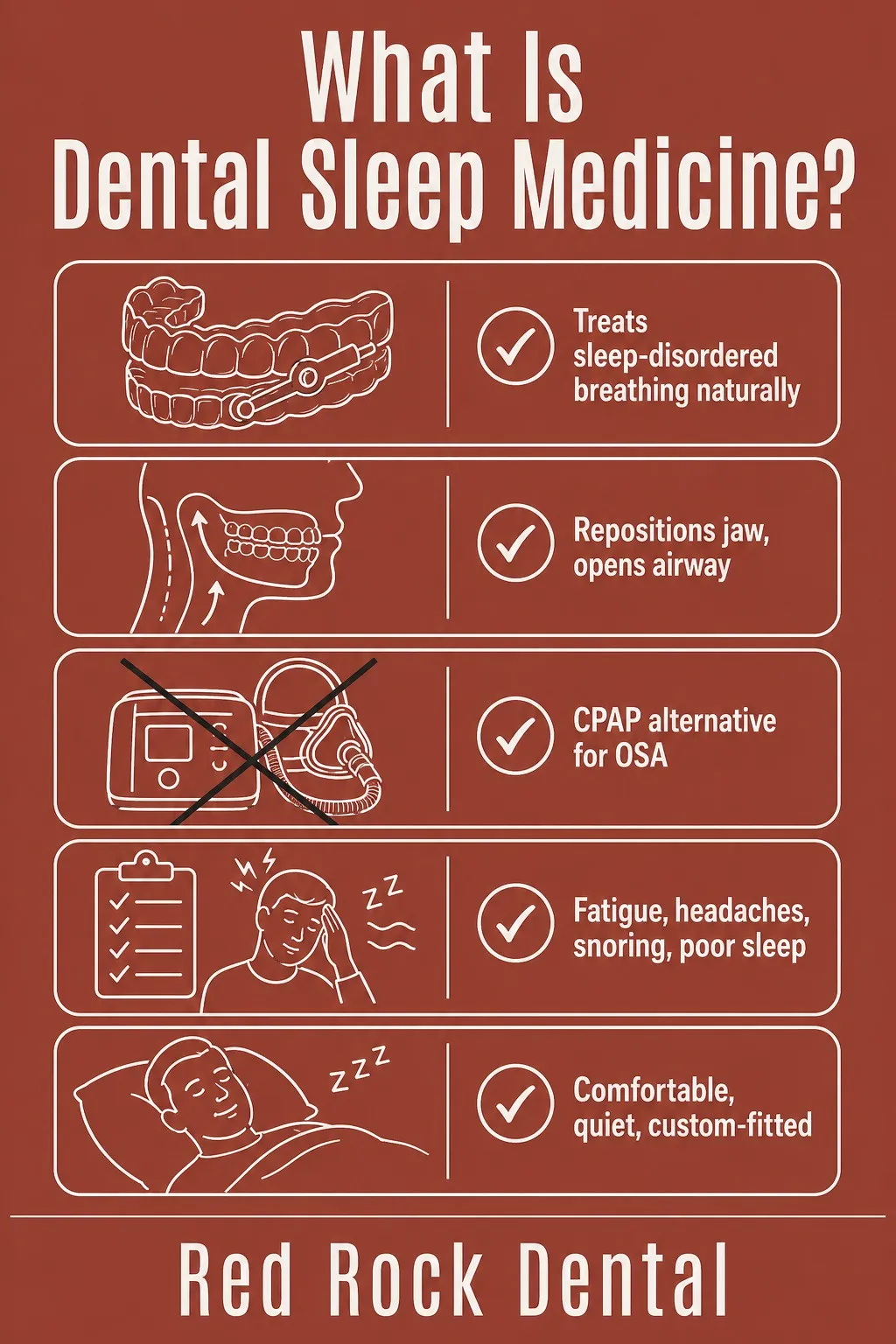
Dental sleep medicine is a field that focuses on using oral appliances to treat sleep-disordered breathing, most commonly obstructive sleep apnea (OSA) and chronic snoring. Rather than relying on machines or medications, this approach uses a custom-fitted device worn during sleep to position the jaw forward and maintain an open airway gently.
How Oral Appliance Therapy Works
An oral appliance looks similar to a night guard or orthodontic retainer, and it fits comfortably over your teeth while you sleep. Repositioning the lower jaw slightly forward prevents the soft tissues of the throat from collapsing and blocking airflow. According to the American Academy of Dental Sleep Medicine, a well-fitted oral appliance can improve sleep quality, restore daytime alertness, and support overall health.
Who Is a Candidate?
Dental sleep medicine is a particularly strong option for patients who have been diagnosed with mild to moderate obstructive sleep apnea, those who snore regularly, and those who have tried CPAP therapy but found it difficult to tolerate. It is also worth exploring whether you have noticed symptoms such as daytime fatigue, morning headaches, difficulty concentrating, or restless sleep. Many patients are surprised to learn that a solution this comfortable and quiet is available through their dental office.
The Connection Between Sleep and Oral Health
Sleep and oral health are more intertwined than most people realize. Patients dealing with sleep-disordered breathing often clench or grind their teeth at night, a condition known as bruxism, which puts significant stress on the teeth and jaw. This can lead to wear, cracking, and discomfort over time. Our team looks at the full picture when evaluating patients, and we consider how issues like TMJ discomfort may connect to disrupted sleep patterns. In fact, our TMJ treatment often intersects with sleep health in meaningful ways, since jaw tension can both contribute to and result from poor sleep.
Addressing sleep-disordered breathing early is a smart investment in your long-term oral and systemic health. Poor sleep has been linked to elevated blood pressure, weakened immune function, and diminished quality of life. At Red Rock Dental, we believe that being proactive about your health today saves you time, money, and discomfort down the road.
What to Expect from the Process
Getting started with dental sleep medicine is straightforward. During your evaluation, our team will assess your airway, bite, and jaw to determine whether an oral appliance is a suitable fit for you. If it is, we take precise measurements to fabricate a custom device that fits comfortably and functions effectively. You may need periodic follow-up appointments to fine-tune the fit and ensure you are getting the best results.
Working with Your Medical Team
Dental sleep medicine works best as a collaborative effort. If you have already received a sleep study and diagnosis from a physician, we will coordinate with your medical provider to ensure your treatment is aligned. If you suspect a sleep issue but have not yet been evaluated, our general dentistry team can help point you in the right direction. A referral for a sleep study is often the first step, and we are here to guide you through every part of the process.
Our services are designed with the whole-health patient in mind, and dental sleep medicine fits naturally into that philosophy. We take pride in offering solutions that are minimally invasive, evidence-based, and tailored to each individual.
Find Rest at Red Rock Dental
Dr. Alan McCaffrey and the team at Red Rock Dental are committed to the kind of conservative, thoughtful care that gets to the root of what is affecting your health and comfort. Dr. McCaffrey devotes over 100 hours each year to continuing education, including training with some of the leading dental clinicians in the country, which means our patients benefit from care that reflects the latest and most effective approaches in the field.
If you have been living with poor sleep, chronic fatigue, or a partner who has mentioned your snoring, it may be time to explore what dental sleep medicine can do for you. We welcome patients throughout the Las Vegas area and are proud to offer Spanish-speaking support for our community. To take the next step toward restful, restorative sleep, contact our office to schedule a consultation.
Frequently Asked Questions About Dental Sleep Medicine
What is a dental oral appliance for sleep apnea?
A dental oral appliance for sleep apnea is a custom-fitted device similar to a night guard or retainer that you wear while sleeping. It works by repositioning the lower jaw slightly forward to keep your airway open and prevent the soft tissues of the throat from collapsing. It is a quiet, portable alternative to CPAP therapy and is most effective for patients with mild to moderate obstructive sleep apnea or chronic snoring.
A dental oral appliance for sleep apnea is a custom-fitted device similar to a night guard or retainer that you wear while sleeping. It works by repositioning the lower jaw slightly forward to keep your airway open and prevent the soft tissues of the throat from collapsing. It is a quiet, portable alternative to CPAP therapy and is most effective for patients with mild to moderate obstructive sleep apnea or chronic snoring.
How do I know if I have sleep apnea?
Common signs of sleep apnea include loud snoring, waking up unrefreshed despite sleeping a full night, morning headaches, daytime fatigue, and difficulty concentrating. A partner noticing pauses in your breathing during sleep is also a strong indicator. The only way to confirm a diagnosis is through a sleep study ordered by a physician. If you suspect you have sleep apnea, our team can help connect you with the right resources to get evaluated.
Common signs of sleep apnea include loud snoring, waking up unrefreshed despite sleeping a full night, morning headaches, daytime fatigue, and difficulty concentrating. A partner noticing pauses in your breathing during sleep is also a strong indicator. The only way to confirm a diagnosis is through a sleep study ordered by a physician. If you suspect you have sleep apnea, our team can help connect you with the right resources to get evaluated.
Is a dental appliance as effective as a CPAP machine?
For mild to moderate obstructive sleep apnea, oral appliance therapy can be as effective as CPAP for many patients and is often preferred because it is quieter, more comfortable, and easier to travel with. CPAP remains the standard recommendation for severe sleep apnea. Because compliance matters as much as effectiveness, patients who cannot tolerate CPAP often achieve better long-term outcomes with an oral appliance they will actually wear every night.
For mild to moderate obstructive sleep apnea, oral appliance therapy can be as effective as CPAP for many patients and is often preferred because it is quieter, more comfortable, and easier to travel with. CPAP remains the standard recommendation for severe sleep apnea. Because compliance matters as much as effectiveness, patients who cannot tolerate CPAP often achieve better long-term outcomes with an oral appliance they will actually wear every night.
Does dental insurance cover oral appliance therapy for sleep apnea?
Coverage for oral appliance therapy varies. Some dental plans include it as a covered benefit, while others do not. Many patients find that their medical insurance covers oral appliances for diagnosed sleep apnea because the condition has systemic health implications. Our team can help you understand your options and work with both your dental and medical coverage to maximize your benefits before treatment begins.
Coverage for oral appliance therapy varies. Some dental plans include it as a covered benefit, while others do not. Many patients find that their medical insurance covers oral appliances for diagnosed sleep apnea because the condition has systemic health implications. Our team can help you understand your options and work with both your dental and medical coverage to maximize your benefits before treatment begins.
Can dental sleep medicine help with teeth grinding?
Yes, there is a meaningful connection between sleep-disordered breathing and bruxism, the clinical term for teeth grinding and clenching. Many patients who grind their teeth at night are doing so in response to airway restriction during sleep. Treating the underlying sleep issue with an oral appliance can reduce grinding behavior, protecting your teeth and jaw from wear and discomfort. Our team evaluates these conditions together rather than treating them in isolation.
Yes, there is a meaningful connection between sleep-disordered breathing and bruxism, the clinical term for teeth grinding and clenching. Many patients who grind their teeth at night are doing so in response to airway restriction during sleep. Treating the underlying sleep issue with an oral appliance can reduce grinding behavior, protecting your teeth and jaw from wear and discomfort. Our team evaluates these conditions together rather than treating them in isolation.
ABOUT THE AUTHOR
Dr. Alan McCaffrey
Dentist, Red Rock Dental — Las Vegas, NV
Dr. Alan McCaffrey brings over 20 years of experience to Red Rock Dental in Las Vegas, where he takes a conservative, minimally invasive approach to implant dentistry, clear aligner treatment, and general dental care. He completes more than 100 hours of continuing education annually and is committed to pricing transparency for every patient.
Schedule a Consultation